

About Governance (Service Mapping)
Governance (formerly Service Mapping) models business context on top of vScope’s discovered assets – services, information assets, vendors, countries, or any entity you define – so you can see impact, ownership, and compliance in one place.
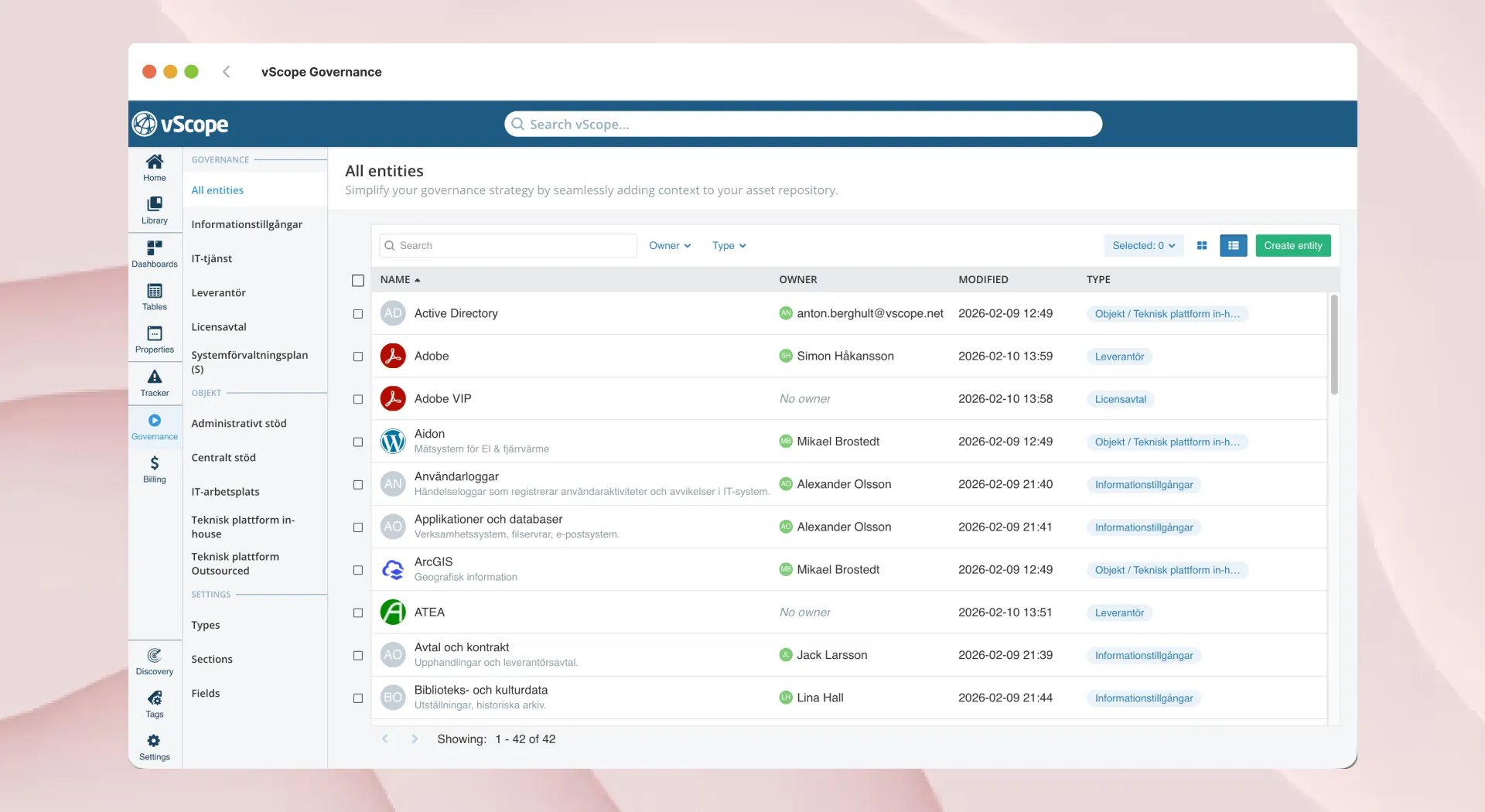
Use it when you need
Section titled “Use it when you need”- Impact analysis: which assets support a service/vendor/region.
- Ownership clarity: who manage/maintains a service or information asset.
- Compliance/SLAs: view posture at the service/entity level.
- Collaboration: keep business and technical context aligned in one place.
- Bridge gaps: combine deep discovery data with the business view.
Key concepts (how it works)
Section titled “Key concepts (how it works)”- Entities: Each entity type (Service, Vendor, Country, etc.) is documented using fields, relations, assets, and metadata.
- Templates: Per entity type define required fields/sections; bundled templates are included and customizable.
- Fields & sections: Reusable inputs/sections to standardize documentation.
- Live data: Linked assets stay updated via Discovery – no manual work required.
- Relations: Map dependencies between entities and assets for impact understanding.
- Collaboration: Visibility is restricted by default; collaborate entities with groups/users for read/write access.
Related articles
Section titled “Related articles”- Interface reference: Governance (Service Mapping) UI
- Concepts: Assets, Relations